Events
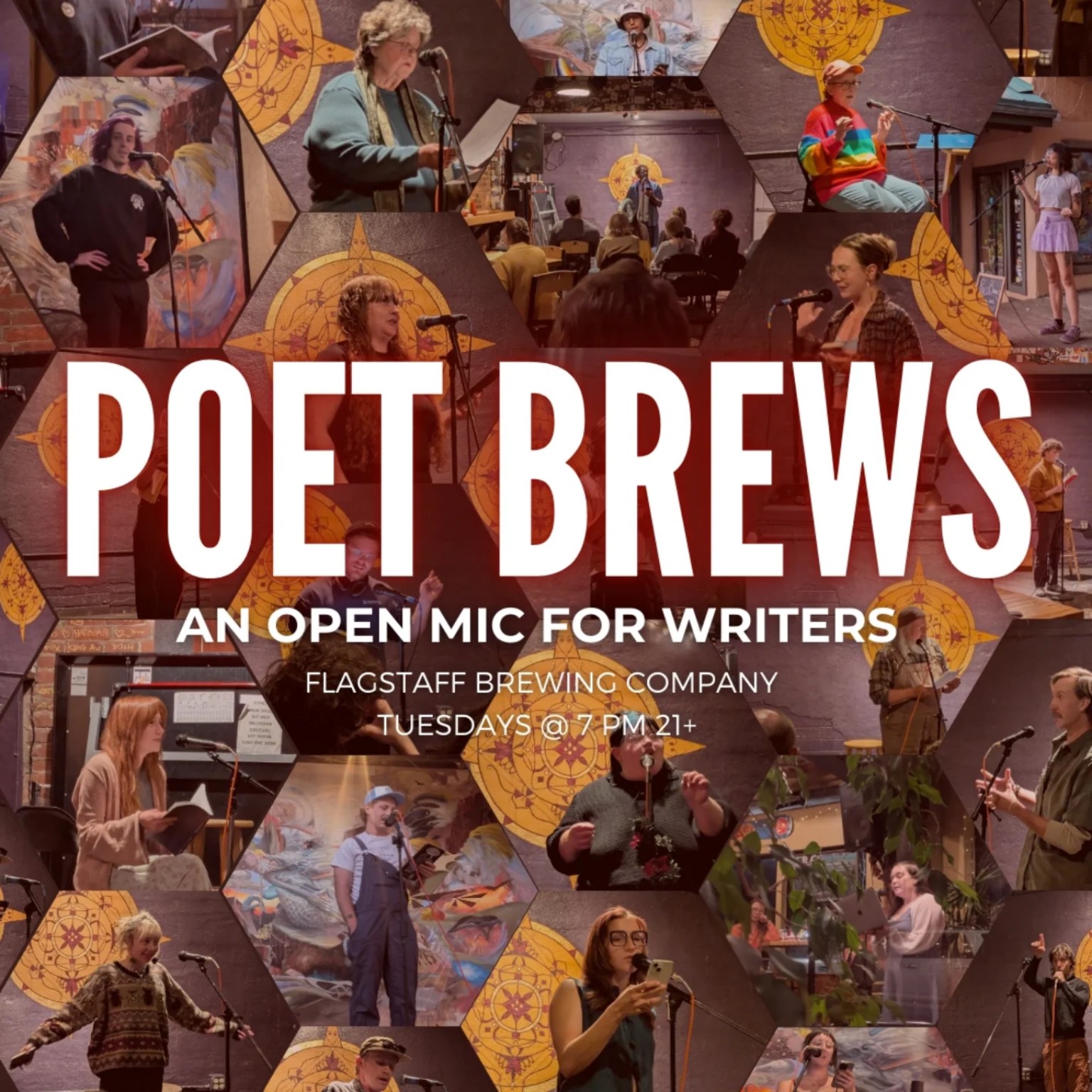
AZpoetry.com is your gateway to the dynamic poetry scene in Arizona. Discover an array of exciting poetry events taking place throughout the state – Arizona poetry open mic nights, poetry slams from Tucson to Bullhead City, AZ poetry workshops, and Grand Canyon State poetry readings! Immerse yourself in the power of spoken word, connect with fellow poetry enthusiasts, and be inspired by the magic that unfolds on stage. Stay up-to-date with our comprehensive event calendar and make sure you never miss a captivating performance.
Poem of the Day
-
- Running in a Red State by Cymelle Leah Edwards
“Running in a Red State” by Cymelle Leah Edwards
Don’t be political.
Sinclair Wash Trail:
Anger is that which your body recognizes as alien; that which has been whittled nonexistent; you temper that emotion at the age of eight when you indulge it and learn that your angry is angrier because it’s also darker; when you serve a man who says he’ll take his coffee like you; standing phone-to-ear at the bus stop when a woman nearby interrupts to say, you have great diction; when he lets his dogs off their leashes as you jog past; in your sleep when this all happens again; you forget what it’s like to be angry until your larynx stiffens from singed resistance; from charred light curdling in the back of your throat.
Don’t sit on a fence.
Woody Mt. Road:
I tried to be both; tried to cinephile-file roles; tried to balance our budget; tried to sleep in my own bed; tried to re-create memories; to be in two places at once; to protract the hours in a day; tried to be honest anyway; tried to sit on my hands so they wouldn’t reach for her; tried to spell without vowels; tried to circumnavigate her body; tried to sorrel our walls; tried to pray it away; to run it away; tried to away; this is when I learned to splinter.
Saying nothing is saying something.
Fat Man’s Loop:
The dogs are off their leashes again, moments before I meet his path. I say to myself, don’t move over this time, let them move over. Let them disrupt their own PRs, mess up their own stride. Close enough to feel heat radiating off his jogging fluorescents, I inch to my right.
I can’t hear you.
Been dreaming about grandma lately, about running into her house after school and watching her rescue the princess on Nintendo classic. She was really good at being Mario, at moving through different worlds, at saving. I’d ask with my small voice can I play? She’d look at my school uniform covered in grass stains, my fingers sticky with the remnants of a pb&j. It’s hot right now, let the machine cool down. I’d wait thirty or so minutes which felt like hours, return to the living room, remove the cartridge and blow.
I could never make it through the underwater theme.
Not choosing is also a choice.
Buffalo Park:
They ride their bikes close so dirt kicks into my nostrils, they look back to watch me cough.
Silence speaks.
Walnut Canyon Ranch:
I learn to give her alfalfa pellets, to stretch my hand out flat, to pet her crest and say, that’s a good girl. I learn to stand parallel with her legs when removing her coat, to pat her bum before I unclip the left hook, to not bother with getting her to like me, she will never like me. I learn that naming a horse is an art. That it took Susan over a year to come up with “Yankee” and that she’s fine with it. I learn their names can’t be more than eighteencharacters, that I’ll never own Ubiquitouuuuuuuuus. I see the rope hanging in their front yard, chalk it up to a game for their grandkids, a tool to swing on. It is the noose at the end that makes me wonder if I should ever return to feed the horses. To find another subset of winona acreage to run through.
Say it, I dare you.
Downtown:
Sometimes, when we experience trauma, we build a boundary of invincibility. We think, the worst has already happened and I survived. At least, this is what I did and still try to fake. I was assaulted last August, seven days after moving to a new town. I knew the guy; we went to high school together. Erring-on-the-side-of-caution was fleeting. I relied on a mutually established sense of trust over four years old. I wrote poems about it, some of which are in the ether right now, being traipsed by cursors and sponged with the fingertips of a stranger. After this event, this uncanny eventuality, I stopped running. This had always been my way of shedding; through perspiration and escapism, I let trees and trail markers lead me through unnerving, undoing, and misremembering. Like most of the runners on my high school track team and those I met while briefly a part of a collegiate team in Seattle, it is our sustenance, theoretically as important as air itself. This, if you couldn’t tell, is written in the vein of writing’s most repudiated word, passion. Back then I was a sprinter, I hadn’t learned to appreciate great distances, pacing, stride, or breath. Sealed-off from the outside world with chain-link barriers, I also didn’t know what it was like to run without the protection of synthetic rubber keeping me from traversing a world unknown.
Forget about how hot it is. I don’t think about it. Running in Arizona is what it is. Hydrate, you’ll be fine. There are other dangers that lurk besides hyperthermia. Suburbs of Phoenix, like Gilbert or Casa Grande (maybe its own town and not a suburb), are mostly white communities. I grew up on the east side of Casa Grande. I built speed being chased by loose dogs in the neighborhood while walking to and from the bus stop. Apoplectic though they may have been, we understood we were helping one another out – me with learning to accelerate, them with their daily exercise. Is this what men with confederate flags billowing from the back of their F-150s believe too?
Who is this little black girl, and what is she running from?
Winning:
Winning a race used to involve medals, ribbons, clout.
Winning means punching code into my garage’s keypad, getting back. Winning is protracting, is living longer than yesterday.
About the poet Cymelle Leah Edwards
Summary and Analysis of “Running in a Red State” by Cymelle Leah Edwards
In “Running in a Red State”, Arizona-based poet Cymelle Leah Edwards crafts a poetic essay that powerfully intertwines personal memory, cultural identity, trauma, and resistance—both literal and figurative. The poem functions as a hybrid narrative, blending free verse, social commentary, and prose poetry with rich specificity of place, capturing scenes from Northern Arizona’s rugged trails to the subtle violence of everyday life in a politically conservative environment.
Structured as a series of meditations mapped across familiar trails like Sinclair Wash, Woody Mt. Road, Fat Man’s Loop, Buffalo Park, and Walnut Canyon Ranch, Edwards navigates what it means to run through a landscape that is at once physically beautiful and symbolically fraught. These trails aren’t merely places for physical movement—they become spaces of reflection, confrontation, survival, and reckoning.
Navigating Rage and Race
The poem opens with the assertion “Don’t be political”, only to dismantle that notion line by line. Edwards presents a litany of moments in which her Blackness is othered: a man making a racialized joke while ordering coffee, a woman praising her “diction” as if surprised, dogs unleashed in spaces where she runs, and the self-awareness that even anger—when expressed through a Black body—is perceived as more threatening. The poet confronts these aggressions with grace and measured defiance, describing them as embers, singed resistance, and “charred light curdling in the back of [her] throat.”
Queer Identity and Duality
On Woody Mt. Road, Edwards explores a layered identity with lines like, “tried to spell without vowels; tried to circumnavigate her body…” Here, she probes queer desire, the constraints of binary expectations, and the impossibility of fitting into a system that doesn’t accommodate complexity. In trying to “be both,” she introduces the metaphor of splitting—learning to “splinter”—and thus illustrates the emotional cost of existing in intersectional spaces that demand singularity.
The Silence of Compliance
At Fat Man’s Loop, the silence becomes palpable. The refusal to yield space—“don’t move over this time”—is itself a radical act. It represents a reclaiming of bodily autonomy and public space. The references to her grandmother playing Mario and saving princesses offer a tender respite from the poem’s heavier subjects. Yet even this nostalgic moment underscores her longing for safety, for someone to “rescue” her.
Violence, Trauma, and Recovery
In one of the most visceral sections—Downtown—Edwards speaks directly to her own trauma. “I was assaulted last August, seven days after moving to a new town.” With brave vulnerability, she recounts the emotional aftermath of sexual violence and the way it disrupted her sense of freedom. Running, once her method of release and healing, became unsafe. Here, Edwards captures the weight of trauma—how it rewires the body’s instincts, maps new caution into muscle memory, and alters a runner’s stride.
Running as Resistance
Despite these dangers, Edwards continues to run. She catalogs the subtle racism of white suburban Arizona—F-150s waving confederate flags, sideways glances, dirt kicked into her nostrils—and continues to find her rhythm.
“Winning is protracting, is living longer than yesterday.”
In this closing line, she redefines survival as success. Her poem is not just about running; it is about reclaiming space, healing, and moving forward through pain, oppression, and silence.
“Running in a Red State” is a poignant testimony to the lived experiences of a Black woman in Arizona, navigating identity, systemic racism, and resilience. Cymelle Leah Edwards’ voice is essential, powerful, and unflinching. Her ability to pair physical movement with emotional evolution makes this poem a landmark piece of Arizona literature.
👉 Learn more about Cymelle Leah Edwards on her AZPoetry.com poet bio page.
- Running in a Red State by Cymelle Leah Edwards
Discover Arizona Poets
-
Laura Tohe
Laura Tohe, Arizona Poet Laureate Laura Tohe is an award-winning poet, writer, scholar, and educator who was recently named the Arizona Poet Laureate, becoming the second person in the state’s history to hold the title. Born in Fort Defiance, Arizona, Dr. Tohe grew up bilingual, speaking both Diné bizaad (Navajo) and English—an experience that continues
-
Lydia Gates
Lydia Gates — Queer Autistic Performance Poet from Flagstaff, Arizona Lydia Gates is a queer autistic performance poet and crochet artist based in Flagstaff, Arizona, where she lives with her wife, Lucy, and their “three adorable feline monster children.” Known for her dynamic stage presence, emotionally incisive writing, and creative interdisciplinary work, Gates has become
-
B-Jam (Ben Gardea)
Arizona Slam Poet, Performer, and Community Builder Ben Gardea, known throughout the Southwest poetry scene as B-Jam, is a nationally recognized slam poet, performer, and workshop leader based in Phoenix, Arizona. A driving force in the Arizona spoken word community, Gardea blends personal vulnerability, rhythmic delivery, and social awareness into performances that resonate across audiences
-
TC Tolbert
TC Tolbert – Tucson Poet Laureate (2017 – 2023) TC Tolbert serves as a vibrant and transformative voice in contemporary American poetry. Appointed as the Poet Laureate of Tucson in 2017, Tolbert guided the city’s literary engagement through 2023, shaping a poetic culture rooted in inclusion, empathy, and the desert’s quiet resilience. Tolbert’s years as
-
Chelsea Guevara
Chelsea Guevara: U.S.-Salvadoran Voice, Slam Champ & Storyteller of Memory & Belonging From Utah Roots to National Slam Triumph Chelsea Guevara is a U.S.-Salvadoran poet and spoken word artist originally from Salt Lake City, Utah. In 2024, she made history by winning the Womxn of the World International Poetry Slam, becoming the first Salvadoran and
-
Ashley Naftule
Ashley Naftule: Phoenix Poet, Playwright & Performance Artist Ashley Naftule (they/them) is a dynamic poet, playwright, performer, and arts journalist based in Phoenix, Arizona. Known for blending speculative themes, queer and trans identity, and razor‑sharp lyricism, Naftule is deeply rooted in Arizona’s creative community through their innovative work at Space55 Theatre and beyond (Planet Scumm).
-
Rex Arrasmith
Rex Carey Arrasmith: Bridging Worlds Through Poetry and Fiction Rex Carey Arrasmith is a poet and fiction writer whose work traverses the landscapes of memory, identity, and the natural world. Splitting his time between Sedona, Arizona, and Lāna’i, Hawaii, Arrasmith draws inspiration from the vortexes of Arizona’s Coconino National Forest and the serene beauty of
-
Gary Every
Sedona’s Storyteller, Poet Laureate, and Genre-Bending Wordsmith Gary Every, the Poet Laureate of Sedona, Arizona, is a literary force known for his genre-defying style, energetic performances, and profound connection to the American Southwest. With over 1,300 publications and nine books to his name, Every has earned recognition in poetry, fiction, journalism, and speculative literature, carving
-
Natasha Murdock
Natasha Murdock: Suburban Elegy and the Poetics of Everyday Awe Natasha Murdock is a poet whose voice emerges from the quiet corners of suburban life, motherhood, and memory. Based in Gilbert, Arizona, Murdock holds an MFA in Poetry from Arizona State University, where she honed a poetic style that embraces clarity, understatement, and emotional depth.
-
Josh Rathkamp
Josh Rathkamp: Arizona Poet, Educator, and Voice of the Everyday Sacred Josh Rathkamp is a celebrated American poet and educator whose work captures the quiet complexities of contemporary life. Born in Saginaw, Michigan, Rathkamp earned his BA from Western Michigan University, followed by an MFA in Poetry from Arizona State University and an MFA in
Browse our database of known poets in Arizona, from the past to present day. Discover the lives of poets, the rich history of wordsmiths in the Grand Canyon State, and plunge into their work through recordings, books, and some poetry that the poets have given us permission to publish here.
🖋️ Share Poetry, Connect with Community 📚
We believe in the transformative power of words and the importance of fostering a supportive community of poets. Whether you’re a seasoned wordsmith or exploring poetry for the first time, AZpoetry.com provides a platform for you to showcase your work and connect with fellow poets. Submit your poetry to our collection, engage in constructive discussions, and receive valuable feedback from our vibrant community.
🌵 Join Our Thriving Poetry Community 🌵
Become a part of our thriving poetry community in Arizona. Connect with like-minded individuals who share your passion for poetry, attend events that will leave you spellbound, and uncover the hidden gems within Arizona’s poetry landscape. Together, let’s celebrate the beauty and power of words.
Start your poetic journey today at AZpoetry.com and let your words create a lasting impact on Arizona’s poetic legacy.