
A Cowboy's Prayer
(Written for Mother)
Oh Lord, I've never lived where churches grow.
I love creation better as it stood
That day You finished it so long ago
And looked upon Your work and called it good.
I know that others find You in the light
That's sifted down through tinted window panes,
And yet I seem to feel You near tonight
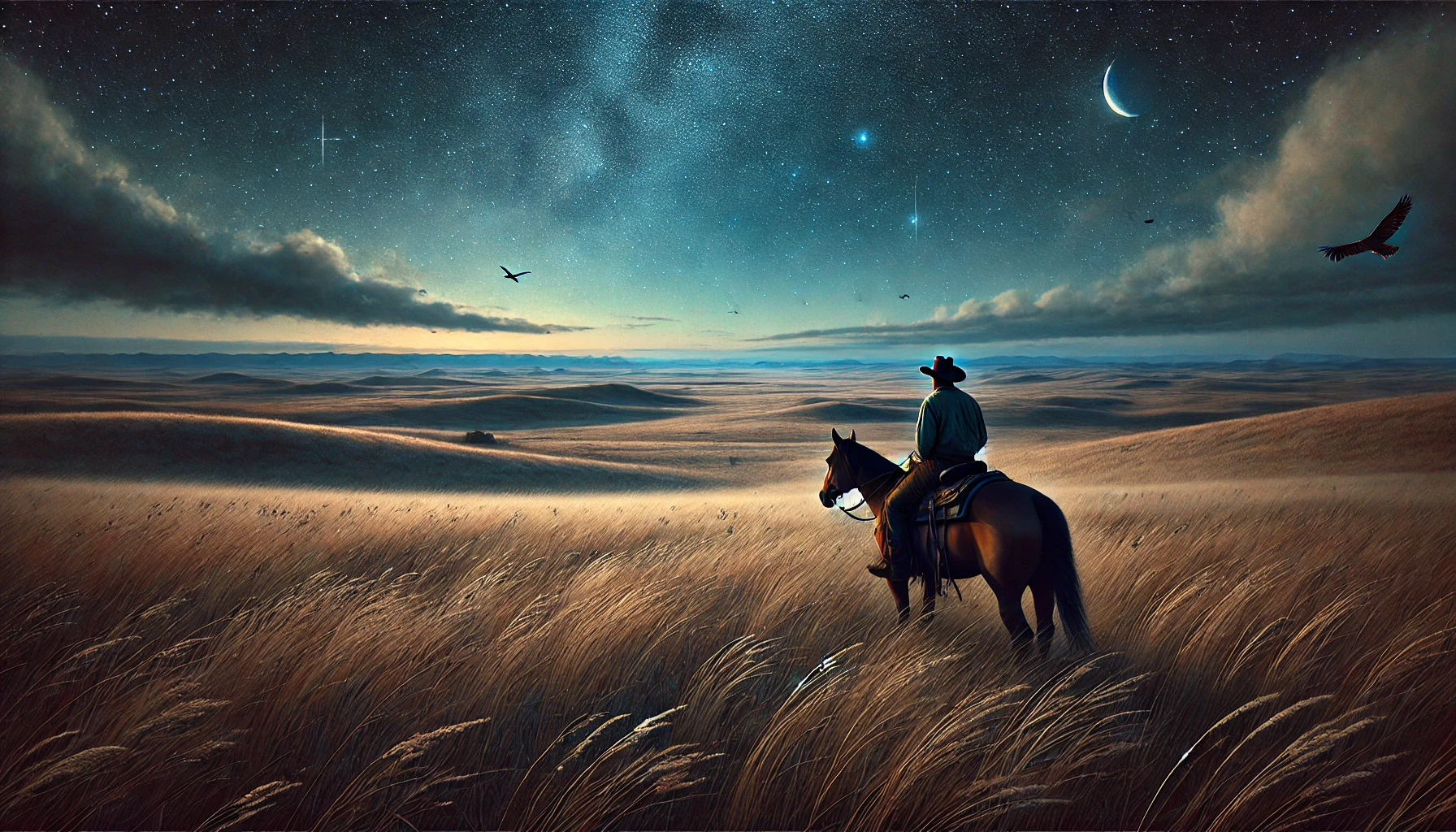
In this dim, quiet starlight on the plains.
I thank You, Lord, that I am placed so well,
That You have made my freedom so complete;
That I'm no slave of whistle, clock or bell,
Nor weak-eyed prisoner of wall and street.
Just let me live my life as I've begun
And give me work that's open to the sky;
Make me a pardner of the wind and sun,
And I won't ask a life that's soft or high.
Let me be easy on the man that's down;
Let me be square and generous with all.
I'm careless sometimes, Lord, when I'm in town,
But never let 'em say I'm mean or small!
Make me as big and open as the plains,
As honest as the hawse between my knees,
Clean as the wind that blows behind the rains,
Free as the hawk that circles down the breeze!
Forgive me, Lord, if sometimes I forget.
You know about the reasons that are hid.
You understand the things that gall and fret;
You know me better than my mother did.
Just keep an eye on all that's done and said
And right me, sometimes, when I turn aside,
And guide me on the long, dim, trail ahead
That stretches upward toward the Great Divide.
About the poet Badger Clark
"A Cowboy's Prayer" was originally written and published in the 1910s by Badger Clark. The poem explores the poet's musings on faith, career, and landscape as pillars of American life. Learn more about the poet HERE.
Summary
A cowboy prays beneath the stars, finding God more readily in open plains, wind, horses and honest work than inside churches. He asks not for comfort or wealth but for freedom, generosity, integrity and guidance along life’s final trail.
Analysis
Clark fuses Christian prayer with the physical vocabulary of cowboy life. Church architecture is contrasted with starlight, walls with open sky, clocks with freedom, and conventional religious virtue with qualities visible in the landscape. The speaker wants to become “big and open as the plains,” honest as his horse, clean as wind and free as a hawk. Nature therefore supplies both the setting for worship and the ethical standard by which the speaker hopes to live. The final “Great Divide” completes the metaphor: a geographical term becomes the distant boundary between life and whatever comes after it.