
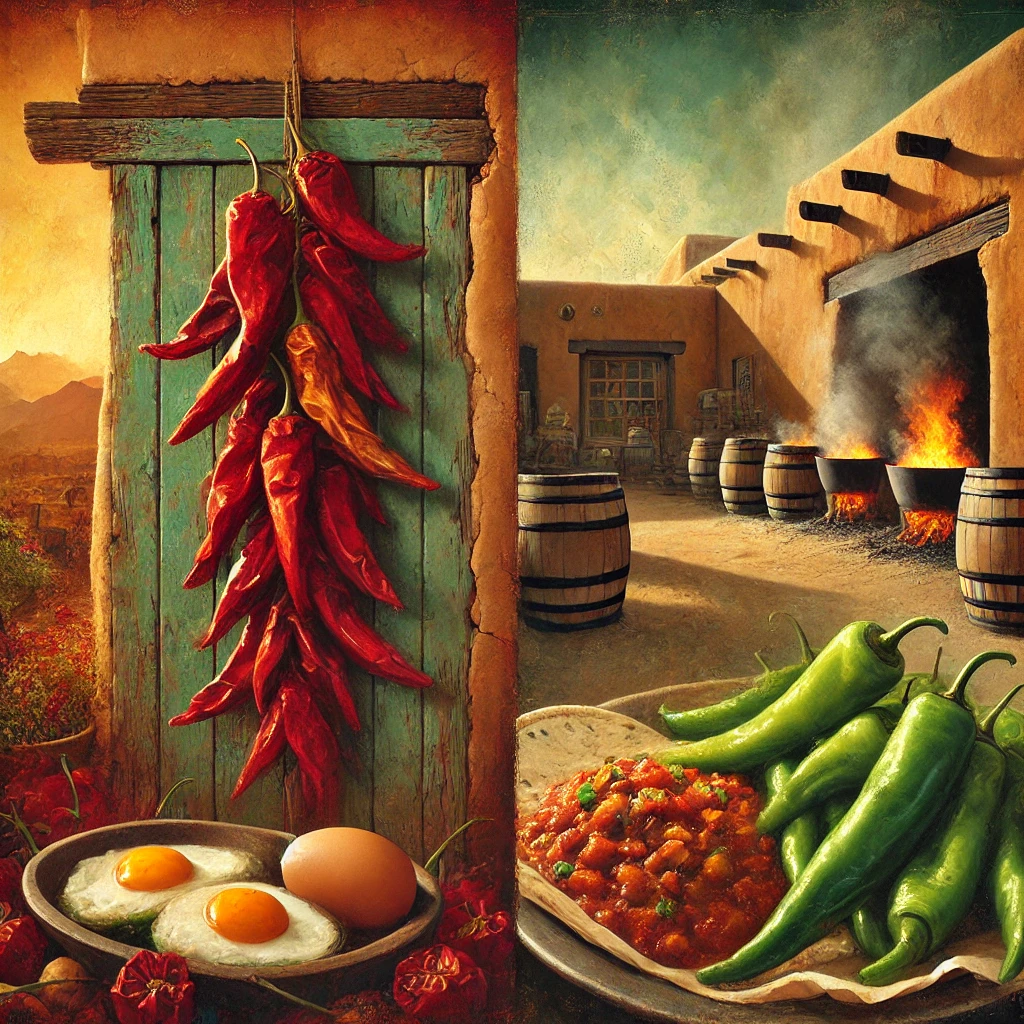
I prefer red chile over my eggs
and potatoes for breakfast.
Red chile ristras decorate my door,
dry on my roof, and hang from eaves.
They lend open-air vegetable stands
historical grandeur, and gently swing
with an air of festive welcome.
I can hear them talking in the wind,
haggard, yellowing, crisp, rasping
tongues of old men, licking the breeze.
But our grandmother loves green chile.
When I visit her,
she holds the green chile pepper
in her wrinkled hands.
Ah, voluptuous, masculine,
an air of authority and youth simmers
from its swan-neck stem, tapering to a flowery
collar, fermenting resinous spice.
A well-dressed gentleman at the door
my grandmother takes sensuously in her hand,
rubbing its firm glossed sides,
caressing the oily rubbery serpent,
with mouth-watering fulfillment,
fondling its curves with gentle fingers.
Its bearing magnificent and taut
as flanks of a tiger in mid-leap,
she thrusts her blade into
and cuts it open, with lust
on her hot mouth, sweating over the stove,
bandanna round her forehead,
mysterious passion on her face
as she serves me green chile con carne
between soft warm leaves of corn tortillas,
with beans and rice–her sacrifice
to her little prince.
I slurp from my plate
with last bit of tortilla, my mouth burns
and I hiss and drink a tall glass of cold water.
All over New Mexico, sunburned men and women
drive rickety trucks stuffed with gunny-sacks
of green chile, from Belen, Veguita, Willard, Estancia,
San Antonio y Socorro, from fields
to roadside stands, you see them roasting green chile
in screen-sided homemade barrels, and for a dollar a bag,
we relive this old, beautiful ritual again and again.
About the Author
Jimmy Santiago Baca is a celebrated Chicano poet, memoirist, and activist who rose from a troubled childhood and years spent in prison to become one of America's most profound literary voices. His works often explore themes of identity, oppression, and personal transformation. Baca's poetry captures the raw power of survival and resilience, making his voice a crucial one in contemporary American literature. For more about his remarkable journey and work, read his full bio here.
Summary
Baca contrasts his preference for red chile with his grandmother’s devotion to green chile, transforming food preparation into a sensual family ritual connected to New Mexico’s landscape, labor, memory, and culture.
Analysis
Chile is never merely food in this poem. Red ristras seem to speak in the wind like old men, while the grandmother handles green chile with deliberately sensual attention before cutting and cooking it for the speaker. That intimacy makes the meal an act of familial love. The final movement expands the kitchen outward across New Mexico, following chile from agricultural fields and trucks to roadside roasting barrels. A private meal becomes participation in a regional ritual repeated “again and again.”