
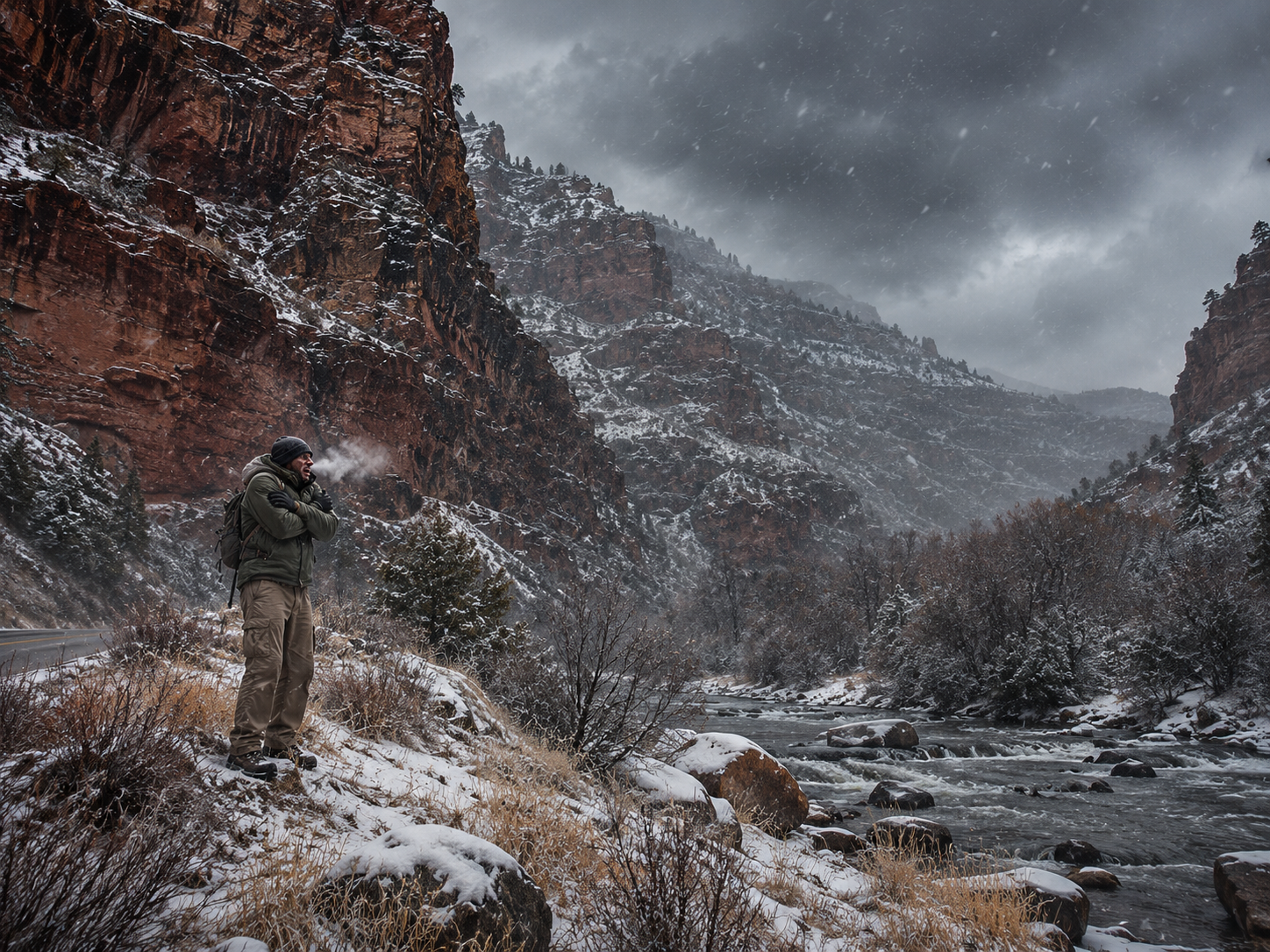
Oh boy
It’s really
Really COLD!
From: Crosswalk Casserole
Summary
In Poem Written While Considering Possibility of Snow Showers in Spanish Fork Canyon, Michael C. Ford transforms an ordinary observation about cold weather into a brilliantly economical piece of humorous poetry. The poem's lengthy, descriptive title establishes an expectation of atmospheric reflection and poetic complexity, only for its three short lines to deliver an exaggeratedly simple reaction to freezing temperatures. The contrast between elaborate anticipation and blunt realization produces a joke that depends as much on the title as on the poem itself.
Analysis
The Title as the Poem
Michael C. Ford demonstrates how a poem's title can carry more narrative weight, context, and implied meaning than the verse beneath it. The unusually long title establishes a specific geographical setting, introduces the possibility of snowfall, and suggests a contemplative encounter with nature.
Yet the poem itself refuses to deliver the sophisticated meditation that the title seems to promise. Instead, the speaker responds with the uncomplicated astonishment of someone discovering that cold weather is, indeed, cold.
This reversal is the poem's central comedic mechanism. The title performs the intellectual preparation, while the body delivers the punchline.
Minimalism, Repetition, and Comic Timing
The poem's three short lines use repetition, conversational language, and deliberate line breaks to control the reader's expectations.
The opening exclamation creates a moment of anticipation. The repeated intensifier delays the inevitable conclusion, while the capitalized final word provides an emphatic, almost cartoonish release.
Ford reduces the experience to its most elementary observation, allowing the contrast with the elaborate title to produce the humor.
The result is a form of literary understatement that becomes funnier precisely because the poem appears to have so little to say.
A Tradition of Literary Playfulness
This approach belongs to a tradition of humorous, minimalist, and deliberately anti-poetic writing associated with Richard Brautigan and the deadpan literary sensibility of Kurt Vonnegut.
Brautigan frequently challenged the expectation that poetry must communicate through elaborate metaphor or elevated language. Here, Ford similarly uses simplicity as a formal strategy, allowing the reader's expectations to become part of the composition.
Arizona poets Bill Campana and Shawnte Orion have also explored the comic possibilities of titles that establish elaborate premises before revealing unexpectedly brief or understated bodies of verse.
In this tradition, the title is not merely a label. It becomes an essential structural component of the poem, sometimes containing more imaginative material than the lines that follow.
Digital Presentation and the Delayed Punchline
The poem gains an additional dimension when presented through a hyperlink.
On AZPoetry.com, encountering the lengthy title as a clickable link creates an unusual opportunity for digital comic timing. The reader absorbs the elaborate premise, clicks to discover the poem, and experiences a brief interval while the page loads.
That physical act of anticipation can become part of the joke.
When the poem finally appears, the enormous difference between the title's complexity and the body's simplicity produces a delayed punchline. The website's navigation effectively creates a pause between setup and resolution.
This demonstrates how digital presentation can enhance the experience of minimalist poetry without altering a single word of the original composition.
Interpretation
Ultimately, Ford's poem finds humor in the distance between intellectual anticipation and ordinary human experience. The elaborate title promises poetic contemplation; the body offers an immediate, instinctive response.
Its achievement is not the observation that the weather is cold, but the careful construction of an expectation that makes such an obvious observation unexpectedly funny.
The poem reminds readers that literary sophistication can sometimes be expressed through an intentional refusal to sound sophisticated.
Explore this poem
Source & rights
Source: Crosswalk Casserole (Lawn Gnome Publishing, First Edition, 2013)
Rights: © 2013 Lawn Gnome Publishing. All rights reserved.